Industry-Ready Graduates for Pharmaceutical Innovation
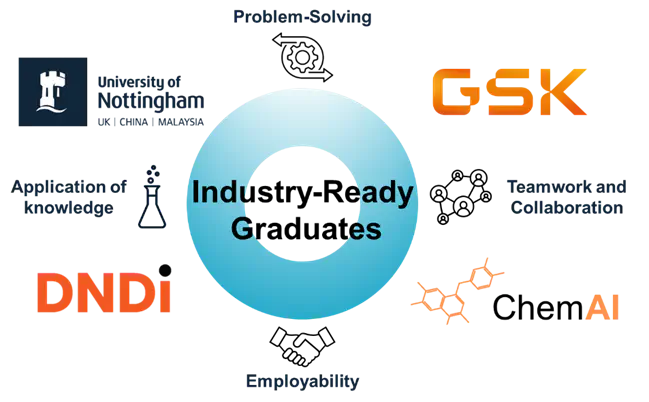
The Industry-Ready Graduates strategy at the University of Nottingham was developed to address a critical skills gap between traditional academic training and the evolving needs of the pharmaceutical industry. The challenge was clear: to produce graduates capable of driving innovation. The programme embeds authentic industrial practices into chemical education and moves beyond conventional laboratory exercises to immerse students in real-world drug discovery workflows. This ensures graduates leave with technical expertise, problem-solving ability and digital readiness.
At the heart of the initiative is experiential learning through live projects that replicate the design–make–test–analyse cycle central to pharmaceutical research. Year 3 modules and MSci research projects tackle genuine challenges such as PI3K inhibitors for asthma, integrin antagonists for fibrotic diseases and neglected disease drug discovery. These projects are delivered in collaboration with GSK and global networks such as DNDi’s Open Synthesis Network (OSN), enabling students to work alongside professional scientists and gain exposure to iterative synthesis and structure–activity relationship (SAR) optimisation. This approach reflects best practice highlighted in chemical education literature, which emphasises authentic, problem-based learning as essential for preparing graduates for complex, data-driven environments.
The programme’s global dimension is particularly impactful. Through OSN, students contribute to neglected disease research by synthesising aminopyrazoles for Chagas disease and sharing data openly with 25 international partners. Nottingham-led projects have produced over 100 analogues with sub-micromolar activity and parasite selectivity, as reported in Journal of Medicinal Chemistry and ACS Infectious Diseases. These outcomes demonstrate how educational initiatives can deliver meaningful scientific contributions while fostering collaboration and open science principles.
The benefits extend beyond technical skills. Students develop critical thinking, adaptability and teamwork – competencies identified as vital for industry readiness. Alumni consistently report that these experiences mirror real pharmaceutical environments, from project planning and iterative design to data-driven decision-making. The initiative has trained over 170 undergraduates in industrially relevant modules, engaged more than 100 students in global neglected disease projects and facilitated direct recruitment into pharmaceutical roles. Tangible outputs include five peer-reviewed publications, spin-out ventures such as Alevin Therapeutics and collaborations in AI-driven reaction optimisation with ChemAI.
By combining cutting-edge science, global collaboration and authentic learning, Nottingham’s model sets a benchmark for chemical education. It not only enhances employability but also demonstrates how universities can contribute to addressing global health challenges through innovative teaching and research integration.
https://pubs.acs.org/doi/abs/10.1021/acs.jmedchem.9b01499

Andrew Nortcliffe
Associate Professor
Andrews pedagogical research focuses on enhancing student engagement and employability through active learning, authentic assessment, and industry-integrated curriculum design in medicinal chemistry.